
How to Build a Custom AI Agent for Your Business
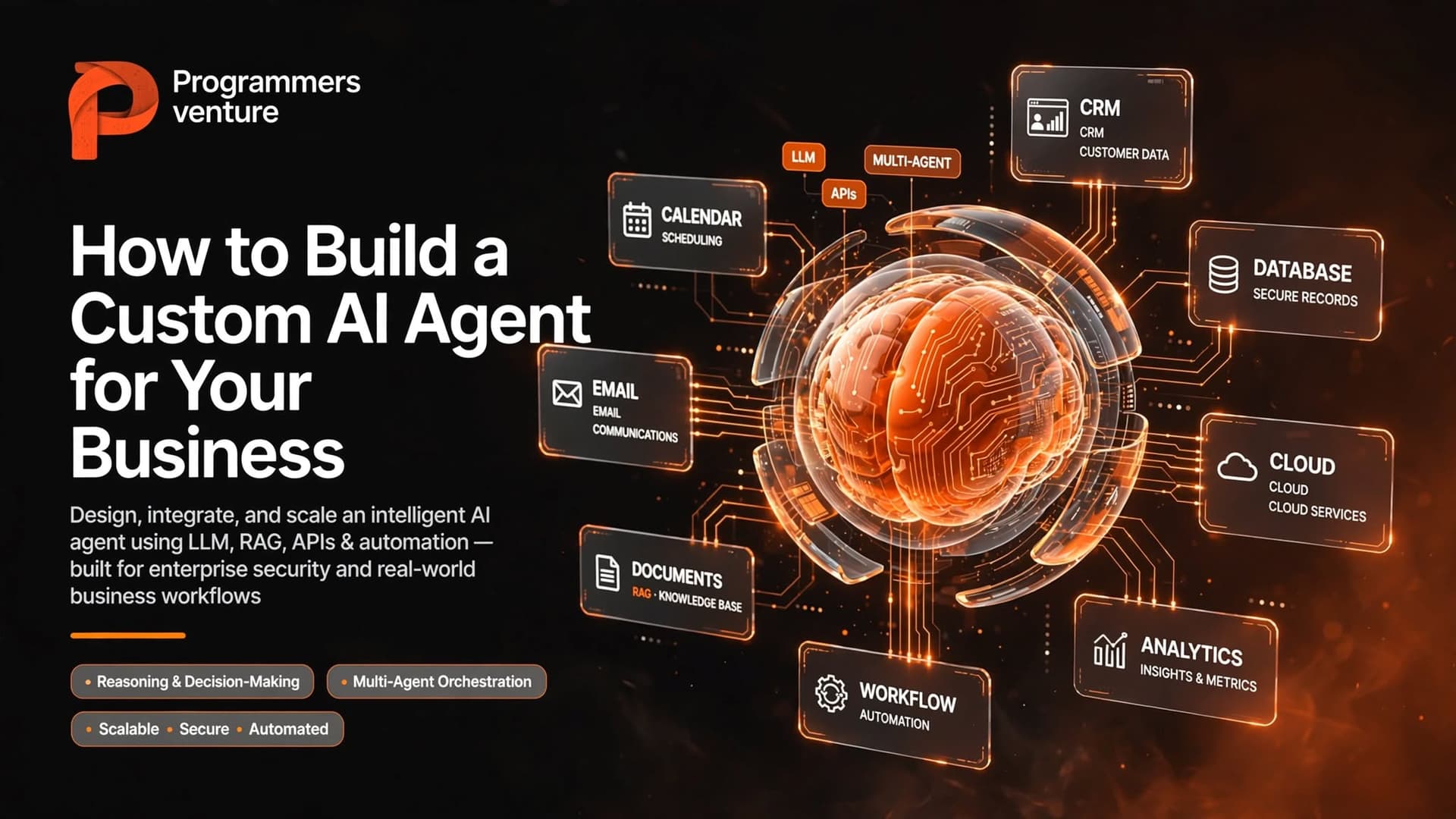
How to Build a Custom AI Agent for Your Business
AI agents are changing how businesses handle customer support, sales, operations, research, data processing, and repetitive tasks. Unlike traditional chatbots that mainly respond to predefined questions, a custom AI agent can understand a goal, make decisions, use business tools, retrieve information, and execute multi-step tasks with minimal human intervention.
For businesses with complex workflows, building a custom AI agent can provide much more flexibility than relying on a generic AI assistant. A properly designed AI agent development solution can connect your existing software, databases, APIs, CRM, communication tools, and internal knowledge into a single intelligent workflow.
This guide explains how to build a custom AI agent for your business, what components are required, common use cases, development costs, technology choices, security considerations, and how to determine whether an AI agent is the right solution for your organization.
What Is a Custom AI Agent?
A custom AI agent is an AI-powered software system designed to perform specific tasks or achieve business objectives by reasoning through a problem, using available tools, accessing relevant information, and taking actions.
Instead of simply generating an answer, an AI agent can potentially:
- Understand a user's request or business objective
- Analyze information from multiple sources
- Retrieve information from company documents and databases
- Call APIs and external services
- Update CRM or ERP records
- Send emails or notifications
- Create reports and documents
- Perform repetitive business processes
- Ask for human approval when required
- Execute multi-step workflows
The important distinction is that a custom AI agent is designed around your business process, rather than simply providing access to a general-purpose AI model.
AI Agent vs Traditional Chatbot
One of the most common questions businesses have is whether they need an AI chatbot or a full AI agent. Although the technologies overlap, they solve different problems.
| Capability | Traditional AI Chatbot | Custom AI Agent |
|---|---|---|
| Answer questions | Yes | Yes |
| Use company knowledge | Sometimes | Yes |
| Call external APIs | Limited | Yes |
| Execute business tasks | Limited | Yes |
| Multi-step reasoning | Limited | Yes |
| Workflow automation | Limited | Yes |
| Human approval workflows | Rarely | Yes |
If your requirement is simply answering customer questions, an AI chatbot may be sufficient. If you want AI to perform tasks and interact with your business systems, an AI agent is usually a more appropriate architecture.
Why Businesses Are Building Custom AI Agents
Generic AI tools are useful for many everyday tasks, but businesses often have workflows that cannot be handled effectively by a general-purpose assistant.
A custom AI agent can be designed around your company's specific processes, permissions, data, software, and objectives.
1. Automate Repetitive Work
Employees often spend significant amounts of time on repetitive activities such as data entry, document processing, email classification, lead research, reporting, and CRM updates.
An AI agent can automate parts of these processes while allowing employees to focus on higher-value work.
2. Connect Multiple Business Systems
A custom AI agent can act as an intelligent layer between different applications. For example, an agent could receive a customer request, retrieve information from a CRM, check inventory through an API, create an internal ticket, and notify the appropriate employee.
3. Improve Customer Experience
AI agents can provide personalized assistance across websites, messaging platforms, voice systems, and internal applications.
Instead of providing generic answers, an agent connected to business systems can use customer-specific information to provide more useful responses and perform appropriate actions.
4. Reduce Manual Decision-Making
Many operational processes involve repetitive decisions based on predefined business rules and available information. AI agents can help analyze these situations and route cases to the appropriate workflow or employee.
For high-impact decisions, businesses can keep a human-in-the-loop so that the AI recommends an action while an authorized employee approves it.
Common Business Use Cases for AI Agents
Custom AI agents can be developed for many industries and departments. Some of the most practical applications include:
AI Sales Agent
A sales AI agent can research prospects, qualify leads, enrich contact information, update CRM records, prepare personalized outreach, and notify sales representatives when a lead meets specific criteria.
AI Customer Support Agent
A support agent can search your knowledge base, answer customer questions, retrieve account information, create support tickets, and escalate complex cases to human representatives.
AI Research Agent
Research agents can collect information from approved sources, analyze large amounts of data, summarize findings, and produce structured reports.
AI Document Processing Agent
Businesses that process large numbers of documents can use AI agents to extract information, classify documents, validate fields, summarize content, and route documents to the appropriate workflow.
AI Operations Agent
An operations agent can monitor business processes, trigger workflows, identify exceptions, update internal systems, and notify employees when intervention is required.
AI Voice Agent
AI voice agents can handle inbound calls, appointment scheduling, customer qualification, basic support, lead capture, and other conversational workflows.
How to Build a Custom AI Agent
Building a reliable AI agent requires more than connecting an application to an LLM API. The development process should begin with the business problem and work backward toward the appropriate architecture.
Step 1: Identify the Business Problem
Start by identifying a specific workflow that consumes significant time, creates operational bottlenecks, or requires repetitive manual work.
Avoid starting with the question, "How can we use AI?" Instead ask:
- What process are we trying to improve?
- What tasks are currently performed manually?
- What information does the process require?
- What systems does the process interact with?
- Which decisions can be automated safely?
- Where should human approval remain necessary?
Step 2: Define the Agent's Responsibilities
Clearly define what the AI agent should and should not be allowed to do.
For example, a sales agent might be allowed to:
- Search company information
- Research leads
- Read CRM records
- Update lead status
- Create follow-up tasks
But it might require human approval before sending a proposal or making a financial commitment.
Step 3: Select the AI Model
The language model is only one part of an AI agent architecture. Depending on your requirements, you may use commercial models, open-source models, or a combination of different models.
Model selection should consider:
- Reasoning capabilities
- Latency
- Token and API costs
- Context window
- Privacy requirements
- Tool-calling capabilities
- Deployment requirements
For some applications, a smaller and faster model may be more appropriate than using the largest available model for every task.
Step 4: Connect Business Data
An AI agent becomes significantly more useful when it can access the information required to perform its job.
Depending on the application, this can include:
- Databases
- CRM systems
- ERP systems
- Internal documents
- Knowledge bases
- Cloud storage
- APIs
- Business applications
For document-heavy applications, Retrieval-Augmented Generation (RAG) can be used to retrieve relevant information from a knowledge base before generating a response.
Step 5: Give the Agent Tools
Tools allow an AI agent to interact with external systems and perform actions.
Examples include:
- CRM APIs
- Email services
- Calendar APIs
- Payment systems
- Database queries
- Search tools
- Document processing services
- Internal business APIs
- Workflow automation platforms
Tool permissions should be carefully controlled. An AI agent should only have access to the systems and actions required for its assigned responsibilities.
Step 6: Design the Agent Workflow
A production AI agent typically needs a workflow that determines how it reasons, selects tools, handles errors, and completes tasks.
More advanced applications can use multi-agent architectures, where specialized agents handle different responsibilities under the coordination of a supervisor or orchestration layer.
For example:
- A research agent gathers information.
- An analysis agent processes the information.
- A writing agent generates the final report.
- A validation agent checks the output.
This architecture is useful when a business process is too complex for a single agent.
Step 7: Add Memory Where Necessary
Some AI applications need to remember previous interactions or maintain information throughout a workflow.
Depending on the use case, memory can include:
- Conversation history
- Customer preferences
- Previous workflow results
- Business context
- Long-term knowledge
Memory should be implemented intentionally. Storing everything indefinitely can increase costs and introduce privacy and data-management concerns.
Step 8: Add Human Approval
Not every task should be completely autonomous.
For sensitive workflows, the agent can prepare an action and request human approval before execution. This approach combines AI automation with human oversight.
Step 9: Test and Monitor the Agent
AI agents can produce different results depending on the input, context, available tools, and model behavior. Production systems therefore require extensive testing and monitoring.
Important metrics can include:
- Task completion rate
- Response accuracy
- Tool execution success rate
- Latency
- LLM usage and cost
- Human escalation rate
- Failure and retry rate
Technology Stack for Custom AI Agent Development
The technology stack depends on the business requirements and the complexity of the agent. A typical architecture can include:
| Layer | Common Technologies |
|---|---|
| Frontend | React, Next.js, Vue |
| Backend | Python, FastAPI, Django, Node.js, .NET |
| LLMs | OpenAI, Anthropic, Google, open-source models |
| Agent Frameworks | LangChain, LangGraph and custom orchestration |
| Vector Database | Pinecone, Qdrant, pgvector, Supabase |
| Automation | n8n, Make and custom workflows |
| Infrastructure | AWS, Azure, Google Cloud, Docker |
The right stack should be selected based on the application's requirements rather than simply following the latest AI technology trend.
How Much Does It Cost to Build a Custom AI Agent?
The cost of custom AI agent development varies significantly depending on the complexity of the workflow, number of integrations, AI models, security requirements, user interface, data sources, and level of autonomy.
A simple AI agent that connects to a small knowledge base and performs a few tasks can be substantially less expensive than an enterprise-grade multi-agent platform integrated with multiple business systems.
Major factors that influence development cost include:
- Number and complexity of workflows
- AI model requirements
- Third-party API integrations
- RAG and knowledge-base implementation
- Database architecture
- Authentication and authorization
- Admin dashboards
- Voice or multimodal capabilities
- Cloud infrastructure
- Testing and monitoring
- Security and compliance requirements
- Ongoing maintenance and optimization
Instead of estimating an AI project based only on the number of screens, businesses should evaluate the complexity of the underlying workflows and integrations.
How Long Does It Take to Build an AI Agent?
Development time depends on the scope of the project.
A focused proof of concept can often be developed much faster than a production-ready platform. Production development may require additional time for authentication, integrations, security, monitoring, testing, deployment, and edge-case handling.
A typical development process can be divided into:
- Discovery: Understand the business process and define requirements.
- Architecture: Design the AI, data, workflow, and integration architecture.
- Prototype: Validate the core AI workflow.
- Development: Build integrations, interfaces, tools, and workflows.
- Testing: Test accuracy, reliability, security, and failure scenarios.
- Deployment: Deploy the solution to the appropriate infrastructure.
- Optimization: Monitor performance and improve the system over time.
Security Considerations for AI Agents
Security becomes particularly important when an AI agent can access internal data or execute actions.
A production AI agent should consider:
- Authentication and authorization
- Role-based permissions
- API security
- Data encryption
- Secret and credential management
- Access control for AI tools
- Prompt injection protection
- Audit logging
- Data retention policies
- Human approval for sensitive actions
The AI model should not automatically receive unrestricted access to your business systems. Tool permissions should be scoped according to the agent's responsibilities.
Should You Build or Buy an AI Agent?
Buying an existing AI solution can make sense when your business requirements closely match the product's capabilities.
Building a custom AI agent becomes more attractive when you need:
- Custom business workflows
- Integration with proprietary systems
- Custom permissions and security
- Private company data
- Industry-specific processes
- Custom user experiences
- Control over your AI architecture
- Integration with multiple internal systems
The right decision depends on the complexity of your requirements, expected return on investment, data requirements, and long-term product strategy.
Common Mistakes to Avoid When Building AI Agents
Starting With the Technology Instead of the Problem
Businesses sometimes start by selecting an AI model or framework before defining what the system actually needs to accomplish. A better approach is to start with the business workflow and select technology afterward.
Giving the Agent Too Much Autonomy
An agent should not automatically have permission to perform every available action. Permissions should be limited to the tasks it needs to perform.
Ignoring Failure Scenarios
Production AI systems need clear behavior for failed API calls, missing information, incorrect outputs, unavailable services, and ambiguous requests.
Building Without Monitoring
AI applications need ongoing monitoring because model behavior, costs, user behavior, and business requirements can change over time.
How Programmers Venture Builds Custom AI Agents
At Programmers Venture, we approach AI agent development as a software engineering problem rather than simply connecting an application to an AI API.
Our approach combines full-stack development, AI engineering, backend architecture, workflow automation, API integrations, and cloud infrastructure to build AI systems around real business requirements.
Depending on the project, an AI solution can include:
- Custom AI agents
- Multi-agent workflows
- RAG-based knowledge systems
- AI-powered SaaS platforms
- AI chatbots and assistants
- AI voice agents
- n8n and business workflow automation
- CRM and third-party API integrations
- Private and self-hosted AI deployments
- Custom AI dashboards and SaaS applications
The goal is not to add AI simply because it is trending. The goal is to identify where AI can create measurable value and then build a reliable system around that opportunity.
Final Thoughts
A custom AI agent can become a powerful part of a modern business when it is designed around a clearly defined workflow and connected to the right data and tools.
The most successful AI agent projects typically start with a specific business problem, validate the opportunity with a focused prototype, and then evolve into a secure and scalable production system.
Whether you need an AI sales agent, customer support agent, research assistant, document-processing system, voice agent, or a more complex multi-agent platform, the architecture should be designed around your business requirements rather than forcing your workflow into a generic AI product.
Need a Custom AI Agent for Your Business?
```If you have a repetitive business process, an AI automation idea, or an existing AI prototype that needs to become a reliable production system, Programmers Venture can help you design and develop a custom solution.
Talk to our team about your AI agent development project and turn your business workflow into a scalable AI-powered system.
```Frequently Asked Questions
What is an AI agent?
An AI agent is a software system that can understand objectives, reason about tasks, use tools, access information, and perform actions to accomplish a specific goal.
How much does it cost to build a custom AI agent?
The cost depends on the agent's complexity, integrations, AI models, data sources, security requirements, and level of automation. A focused AI agent is generally less complex to develop than an enterprise multi-agent platform with numerous integrations.
How long does AI agent development take?
Development time varies according to scope. A proof of concept can be built faster than a production system that requires multiple integrations, security controls, testing, monitoring, and a complete user interface.
Can an AI agent integrate with existing business software?
Yes. Custom AI agents can integrate with CRMs, databases, ERP systems, internal APIs, communication platforms, cloud services, workflow automation tools, and other business applications.
Can an AI agent use our company's private data?
Yes. AI applications can be designed to retrieve information from approved private data sources using approaches such as RAG, secure APIs, databases, and controlled document repositories.
Do AI agents replace employees?
AI agents are often better used to automate repetitive tasks and assist employees rather than attempting to replace every part of a business process. Human approval can remain part of workflows where decisions require accountability or judgment.
Comments (0)
No comments yet. Be the first to share your thoughts!