
How to Build an AI-Powered SaaS Product From Scratch
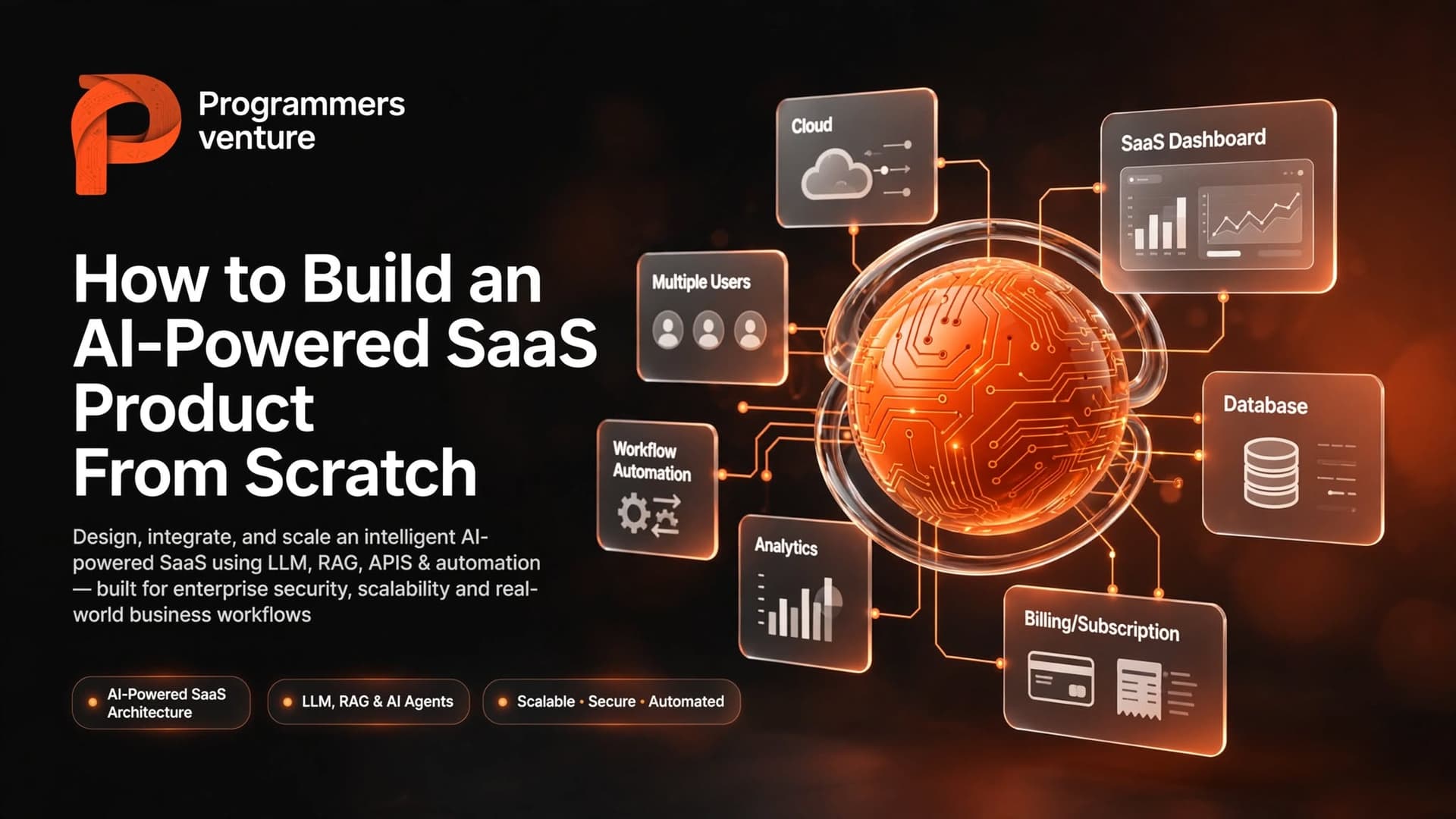
How to Build an AI-Powered SaaS Product From Scratch
AI is transforming the SaaS industry by enabling software products to automate complex tasks, personalize user experiences, analyze large amounts of data, and make intelligent recommendations. For startups and established businesses, building an AI-powered SaaS product can create new revenue opportunities while solving problems that traditional software cannot address efficiently.
However, building an AI SaaS product from scratch requires more than integrating an AI model into a web application. A successful product needs a well-designed SaaS architecture, reliable AI workflows, secure data management, scalable infrastructure, user authentication, billing, monitoring, and a clear product strategy.
In this guide, we explain how to build an AI-powered SaaS product from scratch, including product planning, AI integration, architecture, technology selection, development stages, costs, security, scalability, and common mistakes to avoid.
What Is an AI-Powered SaaS Product?
An AI-powered SaaS product is a cloud-based software application that uses artificial intelligence to provide intelligent features or automate business processes. Users access the application through the internet, typically through a subscription or usage-based pricing model.
Unlike traditional SaaS applications that primarily rely on predefined rules and workflows, AI SaaS products can use technologies such as large language models (LLMs), machine learning, computer vision, natural language processing, retrieval-augmented generation (RAG), AI agents, and intelligent automation.
Examples of AI-powered SaaS functionality include:
- AI content generation
- Document analysis and summarization
- AI-powered search
- Customer support automation
- AI chat assistants
- Sales and lead automation
- Predictive analytics
- AI-powered recommendations
- Voice AI
- Image and video analysis
- AI agents and autonomous workflows
Why Build an AI SaaS Product?
The SaaS model allows businesses to deliver software continuously without requiring customers to install or maintain the application themselves. Adding AI capabilities can make the product significantly more valuable when the technology addresses a real customer problem.
Automate Complex Tasks
AI can automate tasks that traditionally require manual analysis, such as reviewing documents, categorizing information, generating reports, responding to customers, or extracting structured data from unstructured content.
Create Personalized Experiences
AI can analyze user behavior, preferences, historical activity, and business data to provide more personalized recommendations and experiences.
Build New SaaS Business Models
AI enables software companies to create products that were difficult or expensive to build using traditional software development approaches. AI-powered research tools, intelligent assistants, document platforms, and automated workflows are examples of product categories that can be delivered through SaaS.
Scale Operations
Once an AI SaaS platform is properly architected, automated workflows can handle large numbers of requests without requiring the same increase in manual labor.
How to Build an AI-Powered SaaS Product From Scratch
Building an AI SaaS product should be approached as a combination of product development, SaaS engineering, AI engineering, and cloud architecture.
Step 1: Identify a Real Business Problem
The first step is not choosing an AI model. It is identifying a problem worth solving.
A strong AI SaaS idea should answer questions such as:
- Who is the target customer?
- What problem does the product solve?
- How is the problem currently handled?
- How frequently does the customer experience the problem?
- Can AI significantly improve the existing process?
- Would customers pay for the solution?
The best AI SaaS products are not built simply because AI is popular. They use AI to solve a problem where intelligence, automation, or data analysis creates measurable value.
Step 2: Define Your Target Users
Clearly defining the target customer is essential before development begins.
Your product may target:
- Small and medium-sized businesses
- Enterprise organizations
- Marketing teams
- Sales teams
- Developers
- Healthcare organizations
- Financial services companies
- Real estate businesses
- Legal professionals
- E-commerce companies
Your target audience will influence your product features, pricing, security architecture, integrations, onboarding experience, and AI capabilities.
Step 3: Define the MVP
One of the most common mistakes in SaaS development is attempting to build every feature before launching the product.
Instead, define a Minimum Viable Product (MVP) that solves the primary customer problem.
An AI SaaS MVP may include:
- User registration and authentication
- User dashboard
- Core AI functionality
- Basic data management
- Subscription or usage tracking
- Basic billing
- Usage limits
- Basic administration
Additional AI features and integrations can be added after validating the product with real users.
Step 4: Choose the AI Approach
Not every AI SaaS product needs the same type of artificial intelligence. The architecture should be selected according to the actual problem.
Common approaches include:
- LLM integration: For conversational AI, generation, summarization, and reasoning.
- RAG: For answering questions using private or domain-specific information.
- AI agents: For multi-step tasks and tool-based automation.
- Machine learning: For prediction, classification, and structured data analysis.
- Computer vision: For image and video analysis.
- Speech AI: For transcription, voice assistants, and conversational applications.
Some products may combine several of these technologies into a single SaaS platform.
Step 5: Design the SaaS Architecture
A scalable AI SaaS product needs an architecture that separates application logic, AI services, data, authentication, billing, and infrastructure.
A typical architecture may include:
Frontend → User interface and application dashboard
API Layer → Authentication, business logic, and API endpoints
AI Layer → LLMs, agents, RAG, machine learning, or AI services
Data Layer → Relational database, object storage, and vector database
Integration Layer → Third-party APIs and business systems
Infrastructure → Cloud hosting, containers, queues, monitoring, and deployment
The architecture should also consider multi-tenancy, scalability, observability, security, and cost control from the beginning.
Step 6: Implement Multi-Tenancy
If your SaaS application serves multiple customers, you need a reliable multi-tenant architecture.
Multi-tenancy allows multiple organizations to use the same application while keeping their users, data, settings, and permissions isolated.
Your architecture may need to support:
- Organizations and workspaces
- Teams and users
- Role-based access control
- Tenant-specific settings
- Usage limits
- Tenant-level billing
- Data isolation
- Tenant-specific AI configurations
Step 7: Integrate AI Models
Once the SaaS architecture is established, AI models can be integrated into the application.
Depending on the product, you may use commercial AI APIs, open-source models, self-hosted models, or a hybrid approach.
Important considerations include:
- Model quality
- Response latency
- API costs
- Context size
- Privacy requirements
- Data residency
- Reliability
- Tool calling
- Structured output
It can also be useful to support multiple models so that different workloads can use different models according to their performance and cost requirements.
Step 8: Add RAG and Business Knowledge
Many AI SaaS applications need to work with private or domain-specific information.
Retrieval-Augmented Generation (RAG) allows an application to retrieve relevant information from a knowledge base and provide that information to the AI model as context.
A RAG-based SaaS application may use:
- PDF documents
- Web pages
- Knowledge bases
- Company documentation
- Database records
- Product information
- Internal policies
Vector databases such as PostgreSQL with pgvector, Qdrant, Pinecone, or other vector storage systems can be used depending on the architecture.
Step 9: Build AI Agents and Workflows Where Needed
Some AI SaaS products require more than text generation. They need the AI to perform actions.
AI agents can be used to:
- Call external APIs
- Search information
- Query databases
- Process documents
- Send notifications
- Update CRM records
- Execute business workflows
- Perform multi-step tasks
Workflow orchestration frameworks such as LangGraph or custom workflow engines can be used to control complex agent behavior.
Step 10: Add Authentication, Billing and Usage Controls
A production SaaS product requires more than an AI interface.
Important SaaS functionality includes:
- Email and social authentication
- Role-based permissions
- Organizations and teams
- Subscription plans
- Payment processing
- Usage limits
- Invoices
- Trial periods
- Subscription management
- Account and billing settings
AI products should also track model usage because AI inference costs can become a significant operating expense as the customer base grows.
Step 11: Build the Admin Dashboard
A SaaS platform should provide administrators with visibility into customers, usage, subscriptions, system activity, and AI performance.
An admin dashboard may include:
- User management
- Organization management
- Subscription management
- AI usage analytics
- Token consumption
- API usage
- System logs
- Error monitoring
- Feature configuration
Step 12: Test, Deploy and Monitor
AI SaaS applications require testing at multiple levels. Traditional software testing should be combined with AI-specific evaluation.
Important areas include:
- Functional testing
- API testing
- Security testing
- Performance testing
- AI output evaluation
- Prompt testing
- Agent workflow testing
- Failure and fallback testing
- Load testing
After deployment, monitoring should track application performance, AI costs, latency, failures, user behavior, and system availability.
Recommended Technology Stack for AI SaaS Development
There is no single technology stack that is right for every AI SaaS application. However, modern products commonly combine established web technologies with AI-specific infrastructure.
| Layer | Possible Technologies |
|---|---|
| Frontend | React, Next.js, Vue |
| Backend | Python, FastAPI, Django, Node.js, .NET |
| AI Models | OpenAI, Anthropic, Google, open-source LLMs |
| AI Frameworks | LangChain, LangGraph, custom orchestration |
| Database | PostgreSQL, MySQL, SQL Server, MongoDB |
| Vector Database | pgvector, Qdrant, Pinecone, Supabase |
| Automation | n8n, Make, custom workflows |
| Infrastructure | AWS, Azure, Google Cloud, Docker, Kubernetes |
How Much Does It Cost to Build an AI SaaS Product?
The cost to build an AI SaaS product depends heavily on the product's complexity, AI requirements, integrations, user management, infrastructure, and security requirements.
A basic AI SaaS MVP with a focused feature set will generally require significantly less development effort than an enterprise platform with multiple AI workflows, complex integrations, advanced permissions, and large-scale infrastructure.
Key factors that influence AI SaaS development cost include:
- Number of core features
- AI model and API requirements
- Number of integrations
- RAG implementation
- AI agent complexity
- Multi-tenant architecture
- User and organization management
- Subscription and billing functionality
- Admin dashboard
- Cloud infrastructure
- Security and compliance
- Testing and monitoring
Businesses should also account for ongoing expenses such as AI model usage, cloud hosting, databases, storage, third-party APIs, monitoring, maintenance, and support.
How Long Does It Take to Build an AI SaaS Product?
Development time depends on the scope of the product. A focused MVP can be developed considerably faster than a mature SaaS platform with multiple user roles, integrations, AI workflows, billing, analytics, and enterprise security.
A typical AI SaaS development process includes:
- Discovery and planning
- UX and technical architecture
- MVP development
- AI integration
- Business integrations
- Testing and optimization
- Deployment
- Monitoring and continuous improvement
Instead of focusing only on a fixed timeline, businesses should prioritize validating the core product and releasing a stable version that can be tested with real customers.
Security Considerations for AI SaaS Applications
AI SaaS products often process sensitive customer information, which makes security a critical part of the architecture.
Important security considerations include:
- Secure authentication
- Role-based access control
- Tenant data isolation
- Encryption in transit and at rest
- Secure API authentication
- Secrets management
- Audit logging
- Input validation
- Prompt injection protection
- AI tool permission controls
- Secure file handling
- Data retention policies
AI systems should also be designed so that models cannot automatically access sensitive resources beyond the permissions required for their tasks.
How to Keep AI SaaS Costs Under Control
AI infrastructure can become expensive when an application reaches a large number of users. Cost optimization should therefore be considered during architecture design rather than after the product has already scaled.
Use the Right Model for Each Task
Not every request requires the most expensive or powerful model. Different workloads can use different models depending on complexity and performance requirements.
Cache Reusable Results
Caching can reduce repeated model requests when the same or similar information is requested multiple times.
Optimize Prompts and Context
Sending unnecessary information to an AI model increases token consumption. Efficient prompt design and context management can help reduce both latency and operating costs.
Monitor AI Usage
Track usage by customer, organization, feature, and model. This makes it easier to understand where AI costs are coming from and design appropriate pricing and usage limits.
Common Mistakes When Building an AI SaaS Product
Building Too Many Features
Trying to build a complete platform before validating the core idea can increase development costs and delay the launch.
Treating AI as the Entire Product
A strong AI SaaS product is more than an AI model. User experience, workflows, integrations, data architecture, security, billing, and reliability are equally important.
Ignoring AI Operating Costs
AI API usage can become a significant recurring expense. Your pricing and architecture should account for inference and infrastructure costs from the beginning.
Building Without a Scalable Architecture
An architecture that works for ten users may not work for thousands. Database design, queues, caching, asynchronous processing, monitoring, and infrastructure should be considered as the product grows.
Ignoring AI Evaluation
Traditional software tests are not enough for AI features. AI outputs should be evaluated against representative real-world scenarios to identify accuracy, reliability, and safety issues.
Build an AI SaaS MVP First
If you have an AI SaaS idea, you do not necessarily need to build the entire product before testing it with customers.
A better approach is to identify the most valuable workflow, build a focused MVP, validate it with users, collect feedback, and then expand the platform based on actual demand.
This approach can help reduce unnecessary development costs while providing valuable information about product-market fit, user behavior, pricing, and the AI capabilities customers actually need.
Why Choose Programmers Venture for AI SaaS Development?
Building an AI-powered SaaS product requires expertise across both traditional software engineering and modern AI technologies. Programmers Venture combines full-stack development, backend architecture, cloud engineering, AI integration, automation, and SaaS development to build production-ready software.
Our AI SaaS development approach can include:
- AI-powered SaaS application development
- Custom AI integrations
- AI agents and multi-agent workflows
- RAG and private knowledge systems
- AI chat and conversational interfaces
- AI workflow automation
- n8n and API integrations
- Multi-tenant SaaS architecture
- Subscription and billing systems
- Cloud deployment and infrastructure
- AI performance and cost optimization
The objective is to build an AI product that is not only impressive in a demonstration, but also secure, maintainable, scalable, and ready for real users.
Have an AI SaaS Idea?
Whether you have an early-stage AI SaaS idea, an existing prototype, or an application that needs to be rebuilt and scaled, Programmers Venture can help turn your concept into a production-ready SaaS platform.
Talk to our team about your AI SaaS project and explore the right architecture, technology stack, and development approach for your product.
Frequently Asked Questions
What is an AI-powered SaaS product?
An AI-powered SaaS product is a cloud-based software application that uses artificial intelligence to automate tasks, generate content, analyze information, provide recommendations, or deliver intelligent user experiences.
How much does it cost to build an AI SaaS product?
AI SaaS development costs vary based on product complexity, AI functionality, integrations, number of users, security requirements, infrastructure, and development scope. A focused MVP generally requires less investment than a full enterprise platform.
How long does it take to build an AI SaaS application?
The timeline depends on the number of features, AI workflows, integrations, user roles, and technical requirements. A focused MVP can be developed faster than a fully featured enterprise SaaS platform.
Can I build an AI SaaS product using OpenAI or other LLM APIs?
Yes. Commercial LLM APIs can be integrated into SaaS applications for features such as content generation, conversational AI, summarization, classification, reasoning, and AI agents. The appropriate model depends on the application's requirements.
Can an AI SaaS product use private company data?
Yes. AI SaaS applications can be designed to securely retrieve information from private documents, databases, knowledge bases, and internal systems using technologies such as RAG and controlled API integrations.
Can an AI SaaS application support multiple businesses?
Yes. A properly designed multi-tenant SaaS architecture can support multiple organizations while keeping their users, data, permissions, configurations, and usage isolated.
Should I build an MVP before developing the full AI SaaS product?
In many cases, starting with a focused MVP is a practical way to validate the core idea, test the AI workflow with real users, and collect feedback before investing in a larger platform.
Comments (0)
No comments yet. Be the first to share your thoughts!